
22 Mar 2008
The Psalms on Youtube
I have recently updated my Genevan Psalter website by adding to the links page a section titled The Psalms on Youtube. These performances come from the Netherlands and Hungary, where the Psalms have been sung for centuries by Reformed Christians. Having listened to them, I much prefer the Hungarian to the Dutch treatments, but you may judge for yourself. Here are two samples below, the first of which is performed by Vox Humana Choir of Vác under the direction of József Maklári. The arrangements are those of Zoltán Kodály. The first is Psalm 114 and the second 121.

12 Dec 2007
Peculiar 'penalty' no penalty at all
This item caught my eye: Chilean judge sentences Catholic priest to recite psalms for traffic violation. "A judge in southern Chile has sentenced a Catholic priest to recite seven psalms daily for three months as punishment for illegal parking."
I'm sorry, but this is no punishment. Indeed it amounts to a "lite" version of the Liturgy of the Hours, which has been practised in the monasteries for the better part of two millennia. Many nonmonastic priests observe this anyway. By God's grace, it's just possible that, at the end of the three months, he will decide to continue a discipline that will have become part of him.
I'm sorry, but this is no punishment. Indeed it amounts to a "lite" version of the Liturgy of the Hours, which has been practised in the monasteries for the better part of two millennia. Many nonmonastic priests observe this anyway. By God's grace, it's just possible that, at the end of the three months, he will decide to continue a discipline that will have become part of him.
22 Nov 2007
The decline of Psalms in the liturgy
This is a sad account of the decline of Psalms in the western liturgy taken from the 1913 edition of the Catholic Encyclopedia under the entry for "Gradual". I have taken the liberty of breaking it up into paragraphs and deleting the source citations for easier reading.
One of the things the 16th-century Reformers wished to do was to restore the Psalms to worship, an effort that appears to need renewal every generation, even in churches that are heirs to the Reformation. My own website, dedicated to the Genevan Psalter, is intended to be part of this effort.
Gradual, in English often called Grail, is the oldest and most important of the four chants that make up the choir's part of the Proper of the Mass. Whereas the three others (Introit, Offertory, and Communion) were introduced later, [to] fill up the time while something was being done, the Gradual (with its supplement, the Tract or Alleluia) represents the singing of psalms alternating with readings from the Bible, a custom that is as old as these readings themselves. Like them, the psalms at this place are an inheritance from the service of the Synagogue. Copied from that service, alternate readings and psalms filled up a great part of the first half of the Liturgy in every part of the Christian world from the beginning.
Originally whole psalms were sung. In the "Apostolic Constitutions" they are chanted after the lessons from the Old Testament: "The readings by the two (lectors) being finished, let another one sing the hymns of David and the people sing the last words after him." This use of whole psalms went on till the fifth century. St. Augustine says: "We have heard first the lesson from the Apostle. Then we sang a psalm. After that the lesson of the gospel showed us the ten lepers healed."
These psalms were an essential part of the Liturgy, quite as much as the lessons. "They are sung for their own sake; meanwhile the celebrants and assistants have nothing to do but to listen to them." They were sung in the form of a psalmus responsorius, that is to say, the whole text was chanted by one person — a reader appointed for this purpose. (For some time before St. Gregory I, to sing these psalms was a privilege of deacons at Rome. It was suppressed by him in 595.) The people answered each clause or verse by some acclamation. In the "Apostolic Constitutions" they repeat his last modulations.
Another way was to sing some ejaculation each time. An obvious model of this was Ps. cxxxv [Hebrew: 136] with its refrain: "quoniam in æternum misericordia eius" ["for his mercy endures for ever"]; from which we conclude that the Jews too knew the principle of the responsory psalm. . . . It appears that originally, while the number of biblical lessons was still indefinite, one psalm was sung after each.
When three lessons became the normal custom (a Prophecy, Epistle, and Gospel) they were separated by two psalms. During the fifth century the lessons at Rome were reduced to two; but the psalms still remain two, although both are now joined together between the Epistle and Gospel, as we shall see. Meanwhile, as in the case of many parts of the Liturgy, the psalms were curtailed, till only fragments of them were left. This process, applied to the first of the two, produced our Gradual; the second became the Alleluia or Tract. . . .
It is difficult to say exactly when the Gradual got its present form. We have seen that in St. Augustine's time, in Africa, a whole psalm was still sung. So also St. John Chrysostom alludes to whole psalms sung after the lessons. . . . In Rome the psalm seems not yet to have been curtailed: "Wherefore we have sung the psalm of David with united voices, not for our honour, but for the glory of Christ the Lord." Between this time and the early Middle Ages the process of curtailing brought about our present [1913] arrangement.
One of the things the 16th-century Reformers wished to do was to restore the Psalms to worship, an effort that appears to need renewal every generation, even in churches that are heirs to the Reformation. My own website, dedicated to the Genevan Psalter, is intended to be part of this effort.
22 Jun 2007
Song of the Three Youths

I have posted on my Genevan Psalter website my most recent song, a metrical versification of the Song of the Three Youths, variously known also as the Song of the Three Holy Children or simply the Song of the Three. This marvellous hymn of praise is traditionally ascribed to Daniel's three companions from within the fiery furnace after they had been cast there by the Babylonian King Nebuchadnezzar. It does not appear in the Hebrew canon, but it is found in the Septuagint and later translations based on it, where it is inserted into the third chapter of Daniel. Though not strictly regarded as canonical by Christians of the Reformation, it has nevertheless found its way into the church's sung canticles, as found in the Book of Common Prayer and the Lutheran liturgy. Both text and tune I wrote earlier this week. The tune I have titled BENEDICITE, after the Latin name for the canticle, Benedicite Omnia Opera.
This morning I was privileged to examine an ancient edition of the Geneva Bible published in England towards the end of the 16th century. Following the text of the Scriptures itself is a section with liturgical resources, in which the Benedicite finds an honoured place. Indeed it deserves to be known and sung widely by all Christians of every tradition.
30 May 2007
Psalms in wartime
 As a lifelong aficionado of old books, I have made a point of visiting the local antiquarian bookshops while travelling. During a visit to Prague in what was then still called Czechoslovakia in November 1976, I found more than one such shop and purchased a number of volumes dating from the 19th century. One of these was a metrical psalter and hymnal published in 1900, a scanned photograph of which can be found on my Genevan Psalter website.
Another volume dates from 1845 and contains the New Testament and Psalms translated into the Czech language. (Years later I was struck by the irony of my having taken a Bible out of a communist country!) The print is in the old German blackletter and the text uses an older spelling (with "w" for "v", "j" for "i", &c.). The frontispiece (shown above) indicates that this edition was intended for use by "Evangelical Christians of the Augsburg and Helvetic Confessions," i.e., by Lutheran and Reformed Christians.

The Psalms are, of course, of special interest to me, especially the various ways they are used in the course of the liturgy or by individual believers at prayer. Two days ago, while paging through this section, I discovered something I hadn't before noticed. The owner of this volume at the beginning of the 20th century, whose name seems to have been Karel (spelt "Carl" in the handwritten name at the bottom of the page opposite the frontispiece) Lány, read through the Psalms at the pace of one psalm per day (except for Psalm 119), taking time to mark the date at the top of each. (Might it have been this Karel Lány?) He started with Psalm 1 on "1./8.", i.e., 1 August 1914, and continued until he read Psalm 150 on "18./I. 1915", i.e., 18 January 1915.
The timing may not have been incidental. Lány lived in Austria-Hungary, whose heir to the throne, Archduke Franz Ferdinand, had been assassinated in Sarajevo on 28 June. Tensions had mounted after that, with Austria-Hungary issuing an ultimatum to Serbia on 23 July and declaring war five days later. This quickly brought the other European powers onside of either Austria or Serbia, with battles beginning and intensifying into the autumn and winter months. It seems rather likely that Lány — apparently a Lutheran or Reformed Christian living in the predominantly Catholic Czech provinces — turned to the Psalms as the Great War was breaking out.
Perhaps he had a son of conscription age and was concerned for his safety should his country go to war. As a member of a religious minority (and with Hungarian origins at that), he may have sensed how fragile his country's unity really was at the outset of what proved to be the defining event of the 20th century. One can only imagine the subsequent history of this little book. It is possible that Lány lived into the nazi and communist eras, when atheistic régimes made it costly to maintain a public witness to the faith. After Lány's death, the volume may have passed down to his children and grandchildren who were perhaps less appreciative of its significance, selling it to an antiquarian bookseller, whence it came into my hands three decades ago. Of course this can only be speculation.
One thing is certain. While the Battle of Tannenberg was raging to the north between Germany and Russia, Lány read these words from Psalm 27:
Though a host encamp against me,
my heart shall not fear;
though war arise against me,
yet I will be confident.
One thing have I asked of the LORD,
that will I seek after;
that I may dwell in the house of the LORD
all the days of my life,
to behold the beauty of the LORD,
and to inquire in his temple.
For he will hide me in his shelter
in the day of trouble;
he will conceal me under the cover of his tent,
he will set me high upon a rock.
28 Jun 2006
Genevan psalms
During a previous bout with depression five years ago, I was afflicted by a compulsion to paraphrase biblical psalms and arrange their proper Genevan melodies so they could be easily sung. I then posted a website devoted to the Genevan Psalter. Nothing seemed to be effective in curing this compulsion, even that class of medications known as VRIs (versification reuptake inhibitors). Now it appears the compulsion has returned. The local medical community is stumped. Here is the first symptom:
I cried out for God to help me,
cried aloud that God might hear me.
When I languished in distress,
then I sought God’s faithfulness.
Through the night I reached for healing,
yet my heart refused consoling.
Thinking of my God, I sigh,
faint while pond’ring God on high.
You have kept my eyes from sleeping,
too distraught was I for speaking.
I remembered times of old,
former days have I recalled.
In the darkness do I ponder,
in my heart I can’t but wonder:
will God cast away at last?
is his love for ever past?
Have God’s mercies fled for ever?
Will his promise grace us never?
Shall we bear his wrath alone?
Is his steadfast love now gone?
This, I said, is why I’m grieving
and my happiness is leaving:
for the arm of the Most High
for the arm of the Most High
has abandoned us to die.
I recalled the deeds of our Lord,
marvels brought about by his word.
I reflect through all my days
on the wonders of your ways.
God, your paths are our savation,
you subdue the pagan nation.
You redeem us with your arm —
Jacob, Joseph — from all harm.
When the waters saw your power,
depths of sea before you cowered.
Torrents poured out from the sky;
arrows flashed from side to side.
Heaven shook with thunder crashes,
earth was lit by lightning flashes;
Your way led us through the sea,
where your footsteps were unseen.
Like a flock you led your people
in the midst of the upheaval,
by your servants' willing hand,
Moses, Aaron, through the land.
Text and arrangement copyright © 2006 by David T. Koyzis
Text and arrangement copyright © 2006 by David T. Koyzis
22 Oct 2005
Songs of Syon
One of my all-time favourite hymnals is Songs of Syon, subtitled “A Collection of Psalms, Hymns, & Spiritual Songs set, for the most part, to their ANCIENT PROPER TUNES,” edited by the Rev. George Ratcliffe Woodward, M.A. My copy, purchased in 1989 (probably in Toronto), is the 4th edition, published in London in 1923, the original edition having come out in 1904. It is an exceedingly comprehensive collection, containing plainsong melodies, metrical melodies of the 13th to 16th centuries, Lutheran chorales, “Old English and Scotch psalm-tunes” and old French psalms and canticles. It is based on the earlier work of Robert Bridges' Yattendon Hymnal.
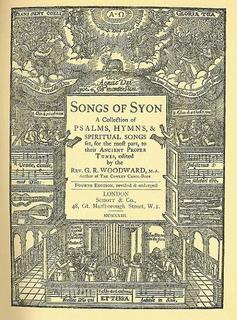
The plainsong texts are generally John Mason Neale’s famous 19th-century translations of the ancient Greek and Latin hymns. These are often rendered in mediaeval musical notation, which, with a little practice, is fairly easily sight-read. The titles of the German hymns are set in blackletter font, perhaps making them appear exotic to an early 20th-century English readership – or should I say “singership”? In his preface to the 4th edition, the Rev. Mr. Woodward felt it necessary to say the following:
The material is organized at the outset in fairly typical manner, i.e., according to the church calendar. Hence Advent hymns come first, followed by Christmas-even, Christmas-tide, &c. Then come Holy Eucharist, Sundays and Week-days, Evensong, Mattins, Common of Our Lady, Common of Saints, Proper of Saints, &c. Then come sections devoted respectively to Psalms, Hymns and Spiritual Songs.
The Psalms section is of particular interest to me, because the editor put some effort into recovering for the English-speaking church the tunes of the Genevan Psalter, which, apart from a very few, are generally unknown to Anglo-Saxon Christians. Some of the translated texts are by Woodward himself. Here is the first stanza of his rendition of Psalm 150:
Eight decades later, Woodward’s effort to recover the Genevan tradition appears largely to have fallen short. But his Songs of Syon stands as a monument to the rich liturgical heritage of both eastern and western Christendom. It deserves to be better known than it is.
Unfortunately I myself do not use this volume as often as I would like. My copy is redolent of mildew to which I am, sadly, allergic. Should I attempt to sing directly out of this book, I would have to stop every few bars to blow my nose. I would love to find a much newer reprint with which to replace this.
The plainsong texts are generally John Mason Neale’s famous 19th-century translations of the ancient Greek and Latin hymns. These are often rendered in mediaeval musical notation, which, with a little practice, is fairly easily sight-read. The titles of the German hymns are set in blackletter font, perhaps making them appear exotic to an early 20th-century English readership – or should I say “singership”? In his preface to the 4th edition, the Rev. Mr. Woodward felt it necessary to say the following:
If objection be taken to the number of foreign tunes which appear in this Edition, be it remembered that many of our favourite Hymn-tunes. E.g., The Old Hundredth, Luther’s Hymn, Adeste fideles, O Sacred Head surrounded, Now thank we all our God, Sing praise to God who reigns above, are not of English origin. It is confidently believed that many other exotics need only to be transplanted, and they will take equally deep root in the hearts of English-speaking people.
The material is organized at the outset in fairly typical manner, i.e., according to the church calendar. Hence Advent hymns come first, followed by Christmas-even, Christmas-tide, &c. Then come Holy Eucharist, Sundays and Week-days, Evensong, Mattins, Common of Our Lady, Common of Saints, Proper of Saints, &c. Then come sections devoted respectively to Psalms, Hymns and Spiritual Songs.
The Psalms section is of particular interest to me, because the editor put some effort into recovering for the English-speaking church the tunes of the Genevan Psalter, which, apart from a very few, are generally unknown to Anglo-Saxon Christians. Some of the translated texts are by Woodward himself. Here is the first stanza of his rendition of Psalm 150:
Alleluya. Praise the Lord;
Be his holy Name ador’d:
Praise him in the firmament,
Mighty, great and excellent:
In his noble acts revere him:
Praise him on the harp and lute,
Praise him with the trump and flute;
Love, adore, and greatly fear him.
Eight decades later, Woodward’s effort to recover the Genevan tradition appears largely to have fallen short. But his Songs of Syon stands as a monument to the rich liturgical heritage of both eastern and western Christendom. It deserves to be better known than it is.
Unfortunately I myself do not use this volume as often as I would like. My copy is redolent of mildew to which I am, sadly, allergic. Should I attempt to sing directly out of this book, I would have to stop every few bars to blow my nose. I would love to find a much newer reprint with which to replace this.
1 Sept 2004
The Genevan Psalter

Those who know me well are aware that I have a considerable affinity for the Psalms. I am reluctant to admit that I have a favourite book of the Bible, since that would seem to have me sitting in judgement on the scriptures. Nevertheless, I freely admit that the Psalms speak to me as does no other part of the Bible. My own daily prayer regimen has me reading a psalm or two per day, which means that I read through this book far more frequently than any of the other books. I love the Psalms for two reasons.
First, they cover a broad emotional range and carry the believer through times of joy and sorrow alike. Much of contemporary liturgy -- at least in protestant churches -- remains at one level. We easily sing God's praises and shout for joy in our worship services. But we rarely complain or lament or call down judgement on the wicked, perhaps because these things are not deemed politically (or should I say liturgically) correct. When was the last time any of us heard Psalm 88 or 137 used in the course of worship?
Second, I love the Psalms because they were meant to be sung. It is often claimed -- at least in some circles -- that, although the Bible prescribes what we are to believe and how we are to live our lives, it does not tell us how we are to worship or prescribe specific liturgical rites. This is only partly true. In fact, the nucleus of the church's liturgy should be the biblical Psalter itself. Yet there are many churches that sing everything but the Psalms, which is not as it should be.
In the 16th century the Reformers sought to render the Psalms in a form that would make them easily singable by ordinary congregations. Thus was born the metrical psalm, which all heirs of the Reformation sang until Pietism and the Enlightenment made Christians slightly embarrassed by the Psalter's typically earthy expressions. One of the more famous of the metrical psalters of the era was the Genevan Psalter, which went through more than one incomplete edition until all 150 Psalms appeared in metrical form in 1562. Some two decades ago I became fascinated by the Genevan Psalter and decided to versify as many of the English texts as possible and arrange their proper melodies so that the Psalms could indeed be sung. Thus far I have completed 50 psalm texts and tunes, which I posted three years ago on a website specially devoted to it. At some point I hope to get this partial collection published so that Christians can actually sing them. Click here to find out more.
Subscribe to:
Posts (Atom)