Psalm 38:
Psalm 51:
Psalm 54:

Unto Thee, O LORD, my Saviour,
I lift up my waiting soul.
O my God, in Thee I trusted;
Let no shame now o'er me roll.
On my enemies be shame,
Oft without a cause transgressing;
But all those who trust Thy Name
Honour with abundant blessing.
LORD, for you my soul is longing;
O my God, in you I trust.
Do not let my foes disgrace me;
stop the taunts of the unjust.
All whose hope is in your name
you will honour with your blessing;
traitors will be put to shame --
those without excuse transgressing.
How blessed is the man whose walk is not
In evil counsel which the wicked plot . . .
How blest is he who shuns the path of sin,
who spurns the counsel of unrighteous men . . .
♪ La Terre au Seigneur appartient ♪ MT
from joe-topc on Vimeo.
Unless the living LORD shall build,
the builders' aims go unfulfilled.
Unless the LORD himself defend,
on sentries we cannot depend.
In vain you early wake to rise;
in vain you close your weary eyes.
Though you may toil to earn your bread,
you'll soundly sleep upon your bed.
Sons are a blessing from the LORD,
the fruitful womb a great reward.
Like arrows in a warrior's hand
are strapping youths who by you stand.
Happy and blessèd are the ones
who find their quiver full of sons:
they will not suffer injury
when challenged by an enemy. [sung to last four lines of music]
CHAPTER XXIII
Of the Prayers of the Church, of Singing, and of Canonical Hours
SINGING. Likewise moderation is to be exercised where singing is used in a meeting for worship. That song which they call the Gregorian Chant has many foolish things in it; hence it is rightly rejected by many of our churches. If there are churches which have a true and proper sermon but no singing, they ought not to be condemned. For all churches do not have the advantage of singing. And it is well known from testimonies of antiquity that the custom of singing is very old in the Eastern Churches whereas it was late when it was at length accepted in the West.
CANONICAL HOURS. Antiquity knew nothing of canonical hours, that is, prayers arranged for certain hours of the day, and sung or recited by the Papists, as can be proved from their breviaries and by many arguments. But they also have not a few absurdities, of which I say nothing else; accordingly they are rightly omitted by churches which substitute in their place things that are beneficial for the whole Church of God.
As the Prophet saith: "Seven times a day I have given praise to Thee" (Ps 118[119]:164), this sacred sevenfold number will be fulfilled by us in this wise if we perform the duties of our service at the time of Lauds, Prime, Tierce, Sext, None, Vespers, and Complin; because it was of these day hours that he hath said: "Seven times a day I have given praise to Thee" (Ps 118[119]:164). For the same Prophet saith of the night watches: "At midnight I arose to confess to Thee" (Ps 118[119]:62). At these times, therefore, let us offer praise to our Creator "for the judgments of His justice;" namely, at Lauds, Prime, Tierce, Sext, None, Vespers, and Complin; and let us rise at night to praise Him (cf Ps 118[119]:164, 62).
My iniquities flood o'er me,
and before me
all my sins are a burden.
My wounds fester without healing,
I am reeling
from my mad and foolish ways.
I am bowed low in my grieving,
scarce believing
that I'll cease from my mourning.
For my loins are racked with burning
from your spurning;
there's no soundness in my flesh.
Foes oppose me without reason
in their treason,
they are many and mighty.
Those who answer good with evil
cause upheaval;
enemies are they of right.
LORD above, do not forsake me,
rather make me
to be near you for ever.
Hurry to become my saviour;
show your favour
to me, my redeeming LORD.
Let vs all Gods praise expres,
Praise him in his holines.
Praise him in the firmament
Of his povver [power] permanent,
And his high magnificency.
Praise him in his greatnes shevved [showed?],
In his goodnes multitude,
VVitnessing his excellency.
Praise him, ioyning vvith the noyse
Both of Trumpets and Hautboyse[1],
Praise him in the Psaltery,
And the Harps svveet harmony.
Laud the Lord with praise abounding,
Timbrel, Taber[2], Fife and Flute,
Organ, Sagbut[3], Cornamute[4],
Laud the Lord, his praise resounding.
Praise to him for his goodnes,
Let the cymbals loud expres
Viall[5], Virginall[6] and lute,
Let not string nor breath be mute,
Him to praise let all indeuer [endeavour].
All his works, aboue, beneath,
VVhat so ere doth moue or breath,
Praise the Lord most blessed euer.
If we keep vigil in church, David [the author of the psalms] comes first, last and central. If early in the morning we want songs and hymns, first, last and central is David again. If we are occupied with the funeral solemnities of those who have fallen asleep, or if virgins sit at home and spin, David is first, last and central. O amazing wonder! Many who have made little progress in literature know the Psalter by heart. Nor is it only in cities and churches that David is famous; in the village market, in the desert, and in uninhabitable land, he excites the praise of God. In monasteries, among those holy choirs of angelic armies, David is first, last and central. In the convents of virgins, where are the communities of those who imitate Mary; in the deserts where there are men crucified to the world, who live their life in heaven with God, David is first, last and central. All other men at night are overcome by sleep. David alone is active, and gathering the servants of God into seraphic bands, he turns earth into heaven, and converts men into angels.
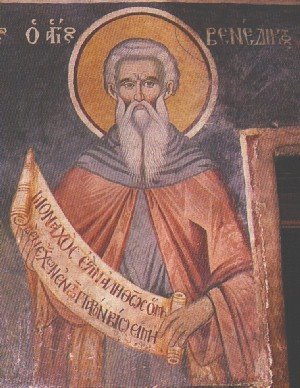 Coincidentally, I have been reading The Rule of St. Benedict, which in some fashion governs the monastic communities in the Benedictine tradition. I am struck by how much my own practice of prayer for the last more than three decades has been shaped by Benedictine spirituality, and especially the place of the Psalms within it. The basic patterns of the Liturgy of the Hours were at least codified, if not created, by St. Benedict in the 6th century. Among other things, Benedict prescribed that all 150 Psalms were to be sung each week. After having set forth the pattern of sung psalms through the successive prayer hours during the night and day, he offers this:
We particularly admonish that if this distribution of the psalms is displeasing to anyone, he should make any other disposition he may think better. Let him take care, however, above all that each week the entire Psalter of one hundred fifty psalms be recited and be always begun anew at the Night Office on Sunday. For those monks show an exceedingly slothful service in their devotion who, within the course of a week, sing less than the entire Psalter with the usual canticles, since we read that our holy Fathers resolutely performed in a single day what we tepid monks but hope to achieve in an entire week.
Behold, how right and good it is whenever
brethren have dwelt harmoniously together!
It is like precious oils that flow
upon the consecrated priestly head;
down to the beard their goodness too is shed;
even to Aaron's beard they go.
Anointing oils flow down along the trimming
of Aaron's garments where their drops are gleaming,
as if the dew that oft descends
on Hermon's mountains were to come and rest
on Zion's mount where God his people blessed
with blissful life that never ends.
Your wrath has swept over me;
your terrors have destroyed me.
All day long they surround me like a flood;
they have completely engulfed me.
And if Christ has not been raised, your faith is futile; you are still in your sins. Then those also who have fallen asleep in Christ are lost. If only for this life we have hope in Christ, we are of all people most to be pitied.

