This is to let everyone know that my two presentations on the Psalms took place earlier this month. The first took place at Redeemer University College on tuesday, 5 April, as I announced late last year. Around 20-25 people attended, some of whom I know, including a former student of mine. I brought along a classical guitar and played my own arrangements of some of the Genevan tunes before the formal part of the talk began. The presentation and discussion lasted around two hours in total with a break in the middle.
Then a week ago I was at Princeton Theological Seminary for the annual Kuyper Center conference titled, "Calvinism and Culture." The keynote speaker and recipient of the Kuyper Prize was Marilynne Robinson, author of Gilead, Home and The Death of Adam. There I presented sections of a paper titled, "Singing the Psalms in the 21st Century: An historical survey and update (or why Abraham Kuyper was wrong about the Genevan tunes)." I hope it will be published in some form in The Kuyper Center Review.
I will here indicate that I am available to present publicly my work on the Psalms elsewhere, for example in churches or educational institutions. If you are interested, please contact me at dkoyzis[at]redeemer[dot]ca.


29 Mar 2011
Phos Hilaron
I have recently posted my freshly composed versification of the ancient Greek hymn, the Phos Hilaron (Φῶς Ἱλαρόν), which is the most ancient Christian hymn outside the Bible itself, dating back at least to the 3rd century AD, if not earlier. It is an evening hymn most appropriately sung at the beginning of vespers in the Liturgy of the Hours. It is first recorded in the Apostolic Constitutions in the 4th century. St. Basil the Great spoke of it as an ancient hymn already in that same century. For the tune I have taken that for Genevan Psalm 77/86 and somewhat extended it to fit the length of the single stanza. The tune is in the hypodorian mode. I may still come up with my own tune at some point.
22 Mar 2011
Praying the Psalms in community
I recently found this wonderful quote from St. John Chrysostom through one of my current students:
 Coincidentally, I have been reading The Rule of St. Benedict, which in some fashion governs the monastic communities in the Benedictine tradition. I am struck by how much my own practice of prayer for the last more than three decades has been shaped by Benedictine spirituality, and especially the place of the Psalms within it. The basic patterns of the Liturgy of the Hours were at least codified, if not created, by St. Benedict in the 6th century. Among other things, Benedict prescribed that all 150 Psalms were to be sung each week. After having set forth the pattern of sung psalms through the successive prayer hours during the night and day, he offers this:
For those of us who are even more tepid than St. Benedict and his followers, some are content to sing through the Psalms every 30 days, as prescribed in the Book of Common Prayer, or at an even slower pace. Inspired by these readings, this past weekend I versified and arranged another psalm, this time Psalm 133, which extols the joys of living in community:
Of course, most of us do not live in monasteries. But what if the ordinary communities of which we are part, namely, families, schools, work communities, &c., were to adopt something of this benedictine spirituality, praying through the psalms together on a regular basis? By God's grace, it could just transform these very communities.
If we keep vigil in church, David [the author of the psalms] comes first, last and central. If early in the morning we want songs and hymns, first, last and central is David again. If we are occupied with the funeral solemnities of those who have fallen asleep, or if virgins sit at home and spin, David is first, last and central. O amazing wonder! Many who have made little progress in literature know the Psalter by heart. Nor is it only in cities and churches that David is famous; in the village market, in the desert, and in uninhabitable land, he excites the praise of God. In monasteries, among those holy choirs of angelic armies, David is first, last and central. In the convents of virgins, where are the communities of those who imitate Mary; in the deserts where there are men crucified to the world, who live their life in heaven with God, David is first, last and central. All other men at night are overcome by sleep. David alone is active, and gathering the servants of God into seraphic bands, he turns earth into heaven, and converts men into angels.
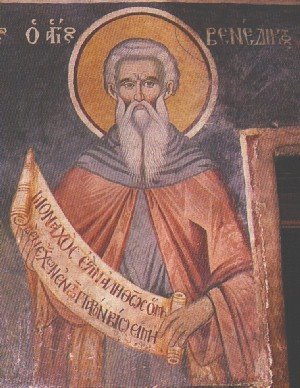 Coincidentally, I have been reading The Rule of St. Benedict, which in some fashion governs the monastic communities in the Benedictine tradition. I am struck by how much my own practice of prayer for the last more than three decades has been shaped by Benedictine spirituality, and especially the place of the Psalms within it. The basic patterns of the Liturgy of the Hours were at least codified, if not created, by St. Benedict in the 6th century. Among other things, Benedict prescribed that all 150 Psalms were to be sung each week. After having set forth the pattern of sung psalms through the successive prayer hours during the night and day, he offers this:
We particularly admonish that if this distribution of the psalms is displeasing to anyone, he should make any other disposition he may think better. Let him take care, however, above all that each week the entire Psalter of one hundred fifty psalms be recited and be always begun anew at the Night Office on Sunday. For those monks show an exceedingly slothful service in their devotion who, within the course of a week, sing less than the entire Psalter with the usual canticles, since we read that our holy Fathers resolutely performed in a single day what we tepid monks but hope to achieve in an entire week.
For those of us who are even more tepid than St. Benedict and his followers, some are content to sing through the Psalms every 30 days, as prescribed in the Book of Common Prayer, or at an even slower pace. Inspired by these readings, this past weekend I versified and arranged another psalm, this time Psalm 133, which extols the joys of living in community:
Behold, how right and good it is whenever
brethren have dwelt harmoniously together!
It is like precious oils that flow
upon the consecrated priestly head;
down to the beard their goodness too is shed;
even to Aaron's beard they go.
Anointing oils flow down along the trimming
of Aaron's garments where their drops are gleaming,
as if the dew that oft descends
on Hermon's mountains were to come and rest
on Zion's mount where God his people blessed
with blissful life that never ends.
Of course, most of us do not live in monasteries. But what if the ordinary communities of which we are part, namely, families, schools, work communities, &c., were to adopt something of this benedictine spirituality, praying through the psalms together on a regular basis? By God's grace, it could just transform these very communities.
18 Mar 2011
The Politics of the Psalms
Perhaps it has something to do with my first name, but I have always been fascinated by the biblical book of the Psalms. I grew up singing from a hymn book in which the Psalms set to meter were given a prominent place. The liturgical practice of singing the Psalms has ancient roots going back to temple and synagogue worship, finding its way also into Christian churches. It is thus not surprising that, until the end of the 18th century, the majority of Protestants sang from metrical psalters containing all 150 Psalms. Most Protestants since then have abandoned this practice, but many in the Reformed tradition have held to it, glorifying God, as it is often said, in his own words.
Read more here.
Read more here.
13 Mar 2011
Updates: Psalms 128 and 88
I have just completed versifications and arrangements for two more psalms: 128 and 88. The tune for Psalm 128 I first heard more than 30 years ago when I was a graduate student at Toronto's Institute for Christian Studies. Senior Member Calvin Seerveld had brought along to class his own versification of this psalm and had us, his students, sing it through. I was intrigued and began to follow in his footsteps, setting to verse Psalm 133 albeit to my own rather weak common metre melody. I finally returned to this psalm late last week.
The psalm itself is one of the more cheerful and optimistic ones, promising peace and prosperity to those who fear the LORD. I completed it last friday, the very day that northeastern Japan was struck by a devastating earthquake and tsunami. Because its promises sounded a little too glib against the backdrop of tragedy, I held off posting it until I had also versified and arranged Psalm 88, easily the darkest of the psalms. This I completed today. Verses 16-17 are reminiscent of a tsunami:
In my own regimen of praying through the psalms, I currently encounter Psalm 88 on the 17th day of each month at morning prayer. It always takes my breath away because it is so bereft of anything resembling hope. It is appropriately said or sung on Holy Saturday, that is, the day between Good Friday and the Paschal feast. As St. Paul puts it in 1 Corinthians 15:17-19:
Yet Christ has indeed risen, which is our ultimate source of hope as we travel through the penitential Lenten season. Psalm 88 does not have the last word, although it is the last psalm for morning prayer that day. However, at evening prayer Psalm 89 is sung, which begins: "I will sing of the LORD’s great love forever; with my mouth I will make your faithfulness known through all generations." God's faithfulness has the final say as we look forward to the day of our salvation at Christ's return.
Psalm 128 is a rhymed psalm, while Psalm 88, with its feminine endings in four of the six lines, is unrhymed. Both melodies are in the dorian mode, which is probably the most versatile of the traditional church modes, easily capable of communicating both hope and despair. More of the Genevan Psalms are in the dorian mode (45 in total) than in any other single mode.
The psalm itself is one of the more cheerful and optimistic ones, promising peace and prosperity to those who fear the LORD. I completed it last friday, the very day that northeastern Japan was struck by a devastating earthquake and tsunami. Because its promises sounded a little too glib against the backdrop of tragedy, I held off posting it until I had also versified and arranged Psalm 88, easily the darkest of the psalms. This I completed today. Verses 16-17 are reminiscent of a tsunami:
Your wrath has swept over me;
your terrors have destroyed me.
All day long they surround me like a flood;
they have completely engulfed me.
In my own regimen of praying through the psalms, I currently encounter Psalm 88 on the 17th day of each month at morning prayer. It always takes my breath away because it is so bereft of anything resembling hope. It is appropriately said or sung on Holy Saturday, that is, the day between Good Friday and the Paschal feast. As St. Paul puts it in 1 Corinthians 15:17-19:
And if Christ has not been raised, your faith is futile; you are still in your sins. Then those also who have fallen asleep in Christ are lost. If only for this life we have hope in Christ, we are of all people most to be pitied.
Yet Christ has indeed risen, which is our ultimate source of hope as we travel through the penitential Lenten season. Psalm 88 does not have the last word, although it is the last psalm for morning prayer that day. However, at evening prayer Psalm 89 is sung, which begins: "I will sing of the LORD’s great love forever; with my mouth I will make your faithfulness known through all generations." God's faithfulness has the final say as we look forward to the day of our salvation at Christ's return.
Psalm 128 is a rhymed psalm, while Psalm 88, with its feminine endings in four of the six lines, is unrhymed. Both melodies are in the dorian mode, which is probably the most versatile of the traditional church modes, easily capable of communicating both hope and despair. More of the Genevan Psalms are in the dorian mode (45 in total) than in any other single mode.
8 Mar 2011
Updates: Psalms 111 and 112
Last month I mentioned that I had posted Psalm 111, but I will say a bit more about this psalm now that I have posted 112 as well. Psalms 111 and 112 are in effect mirror psalms comparing God with the godly person. It may be justly said that the notion of man being created in God's image, often thought to be limited to Genesis 1:26-27 and 9:6 and implied in Psalm 8, is also found in these two psalms. Both are alphabetical acrostic psalms containing 22 lines each. Each line of 111 is reflected in some fashion in its counterpart in 112, conveying the sense that, e.g., if the justice or righteousness of God endures for ever, so does that of the just man (the ו VAV line is identical in both psalms). The alleluias at the beginning of each psalm precede the alphabetical lines.
Although the Genevan tunes for the two psalms have different metres (889 889 and 999 999), they nevertheless have the same number of lines per stanza. With four stanzas in my own versification, this adds up to 24 lines in total, two more than the number of letters in the Hebrew alphabet. Consequently, I have had little choice but to expand slightly the thoughts contained in the first stanzas of each psalm while following the number of lines from the original in the remaining stanzas. The texts are unrhymed.
Both tunes are in the dorian mode. That for 111 is shared with Psalms 24, 62 and 95, while the tune to Psalm 112 is unique to that psalm.
Although the Genevan tunes for the two psalms have different metres (889 889 and 999 999), they nevertheless have the same number of lines per stanza. With four stanzas in my own versification, this adds up to 24 lines in total, two more than the number of letters in the Hebrew alphabet. Consequently, I have had little choice but to expand slightly the thoughts contained in the first stanzas of each psalm while following the number of lines from the original in the remaining stanzas. The texts are unrhymed.
Both tunes are in the dorian mode. That for 111 is shared with Psalms 24, 62 and 95, while the tune to Psalm 112 is unique to that psalm.
4 Mar 2011
Updates: Psalms 70 and 80
Psalms 70 and 80 have now been posted. Psalm 70 is an unrhymed metrical versification set to a tune in the phrygian mode. Since ancient times the first two lines of this psalm have been used to open the prayers in the liturgy of the hours, especially at vespers. Here the psalmist cries out to God for help in distress brought on by his enemies. The Hebrew superscript ascribes it to David, while the Septuagint indicates merely that it is for him or pertains to him.
Psalm 80 is striking in that it obviously originates in the northern kingdom of Israel after its division from Judah following the death of Solomon. It relies, somewhat curiously, on a mixed metaphor. As in the beloved Psalm 23, God is likened to a shepherd, yet his people are likened, not to sheep, but to a vine which he took from Egypt and planted so that its tendrils would spread from the river (the Jordan or perhaps even the Euphrates) to the sea. The reference in verse 17 to the "son of man" could perhaps be understood as an anticipation of the coming Messiah, the True Vine. This is a rhymed versification and the tune is in the dorian mode.
Psalm 80 is striking in that it obviously originates in the northern kingdom of Israel after its division from Judah following the death of Solomon. It relies, somewhat curiously, on a mixed metaphor. As in the beloved Psalm 23, God is likened to a shepherd, yet his people are likened, not to sheep, but to a vine which he took from Egypt and planted so that its tendrils would spread from the river (the Jordan or perhaps even the Euphrates) to the sea. The reference in verse 17 to the "son of man" could perhaps be understood as an anticipation of the coming Messiah, the True Vine. This is a rhymed versification and the tune is in the dorian mode.
16 Feb 2011
February updates

This is a noteworthy recording rendering the Genevan Psalms in contemporary jazz style, employing a full array of instruments. The group generally sings in Dutch, but this is their first English-language album. With their unique treatments, they make the Genevan tunes sound as if they were composed the day before yesterday, although they do alter the melodies and rhythms somewhat to fit their purposes. For example, the well-known tune to Psalm 138 they effectively move from ionian to mixolydian mode, giving it nearly a Celtic flavour. In the hands of The Psalm Project, Psalm 150 takes on the flavour of a lively African-American gospel song. The results will likely win over even the classical music aficionado. Unlike many contemporary treatments of scripture songs, they do not restrict their efforts to psalms of praise, but are willing to tackle such lamentations as found in Psalm 22. Perhaps unsurprisingly they have not thus far touched the imprecatory psalms. Check out The Psalm Project's Dutch and English websites.
CDs can be purchased in Europe: info@thepsalmproject.nl, in the United States: Calvin College Campus Store, and in Canada: psalms@newmaker.net.
Here is a sample from the album:
15 Jan 2011
Genfi Zsoltar: the Psalms in Hungarian
 I have posted a link on both my bibliography and links pages to a pdf file of the Psalms in Hungarian. These versifications were the work of Albert Szenci Molnár (1574-1639), or Szenci Molnár Albert. (In the Hungarian language the "Christian name" comes last with the family name coming beforehand. In Molnár's case Szenci refers to his birth village of Senec, near the city of Pozsony, now Bratislava, Slovakia. A not uncommon family name, Molnár means "miller" and obviously refers to a forebear's occupation.)
A Reformed pastor, Molnár travelled widely during his life, visiting and studying in a number of European centres of the Reformation. His metrical translation of the Psalms was inspired by the German-language Lobwasser Psalter and was published in Herborn in 1607. (The Reformed Christian legal theorist Johannes Althusius had published his Politics in Herborn a few years earlier but had moved to Emden before Molnár's arrival.) He died in Kolozsvár in Hungarian Transylvania, now Cluj-Napoca, Roumania.
The following video shows choral performances of Psalms 19 and 128, using Molnár's texts:
3 Jan 2011
31 Dec 2010
Year-end updates


My thus far preliminary research has raised some intriguing questions worth further exploration. First, might Strejc have met Lobwasser personally in Königsberg and thereby come under his more direct influence?
Second, given that the Kirchengesänge were produced by the same group of which Strejc was a minister, might this be evidence of a connection between the tunes for Psalm 138 and Mit Freuden Zart? To be sure, Strejc's versification of that Psalm came later, but might the Unity of the Brethren have become aware of the Genevan tunes earlier, and might it have been through Strejc? Tellingly, the Lutheran Book of Worship (1978) ascribes the tune directly to the "Trente quatre pseaumes de David, Geneva, 1551." These two possibilities are probably mutually exclusive.
Third, if Lobwasser based his translations on the French text of Marot and Bèze (for which he was criticized by his Lutheran colleagues), and if Strejc based his translations on Lobwasser's German text, how true are Strejc's texts to the Hebrew? Only someone conversant in all four languages would be able to answer this question.


By the way, the city of Königsberg has been called Kaliningrad since 1945 and has been part of the Russian Federation. At some point there was talk of changing the name (Kalinin was a Stalin-era Soviet functionary) to honour its most famous citizen, Immanuel Kant. I would like to suggest as an alternative that it be renamed for either Lobwasser or Strejc. Or even both: Lobwasserstrejcgrad!
I might point out that, amongst the Dutch Canadians I know personally, many dislike intensely this style of singing and their churches have thus altogether abandoned the Genevan Psalms for more contemporary fare. I find this tragic, and my own efforts over the past quarter century are intended to recover the Genevan tradition and to make it more singable for younger generations of Christians in a variety of traditions.
28 Dec 2010
Huckaby on the psalms
Chuck Huckaby has expanded his earlier post on the Genevan Psalms for The Worldview Church: Reviving Personal Devotion through use of the Genevan Psalms. In the course of this article he is kind enough to mention my own work in this area.
19 Dec 2010
The Psalm Project
I have recently been made aware of The Psalm Project, a group of young Christian musicians in the Netherlands who are rendering the Genevan Psalms in contemporary form. Here is a medley of their efforts below, which are quite compelling:
Here are Psalms 86, 119 (partial, obviously) and 139:
Update: How would The Psalm Project render the imprecatory psalms such as the closing verses of Psalm 137? Are their contemporary versions of the Psalms capable of accounting for the quite varying spiritual and emotional range of the collection? I will be interested to follow their efforts to see how, or whether, they will treat these.
Here are Psalms 86, 119 (partial, obviously) and 139:
Quite honestly, I do not recommend the microphoned performance style for liturgical use, as it calls too much attention to the singers, whose voices unduly dominate rather than support those of the congregation. Nevertheless, taken as performance music, these pieces are quite nice and worth listening to.
Update: How would The Psalm Project render the imprecatory psalms such as the closing verses of Psalm 137? Are their contemporary versions of the Psalms capable of accounting for the quite varying spiritual and emotional range of the collection? I will be interested to follow their efforts to see how, or whether, they will treat these.
14 Dec 2010
Salmo 2
The following Portuguese-language version of Psalm 2 is set to the Genevan tune and begins the same as this CBS rendition, but from there the two texts part ways.
13 Dec 2010
Afrikaans Psalter link
With the gracious permission of Josef du Toit, I have now posted the Afrikaans-Geneefse Psalmboek on our server with a link from the links page. Heart-felt thanks to Mr. du Toit.
10 Dec 2010
The Psalms in Brazilian Portuguese
A Brazilian acquaintance, Guilherme de Carvalho, has drawn my attention to a Portuguese-language article by Lucas G. Freire, titled A igreja deveria cantar mais os salmos, translated into English as The church should sing psalms more. Freire is a member of the Brazilian Committee on Psalmody (Comissão Brasileira de Salmodia, or CBS), which is undertaking to versify all 150 Psalms in the Portuguese language. The fruit of these efforts can be found at Saltério Reformado. Those versifications with Freire's name at the bottom are first drafts. Those attributed to CBS are final drafts. The intention is to have 150 Psalms set to the Genevan tunes and 150 Psalms set to more familiar hymn tunes. The collection should come out sometime next year. We wish Freire and the entire committee God's guidance and blessings as they undertake this important work for his glory.
7 Dec 2010
Psalter resources
Chuck Huckaby, pastor of St. Andrews Church, Lawrenceburg, Tennessee, recommends a number of resources related to the Genevan Psalter, including the forthcoming new Canadian Reformed psalter: Updated Anglo Genevan Psalter Unveiled. Although this collection is known as both the Book of Praise, a title used since at least 1897 for the Presbyterian Church in Canada's psalter and hymnal, and Anglo-Genevan Psalter, a title given to the collection published in 1556 in Geneva by English clergy exiled during the reign of Queen Mary, no one is likely to confuse the new psalter with either of these earlier works. A preview can be found here.
2 Dec 2010
The Psalms in Afrikaans

The Afrikaners of South Africa have their origins in a trading post established by the Dutch East India Company in 1652 at the Cape of Good Hope. The original Dutch settlers were joined by subsequent migrations from France and Germany, as seen in the surnames of many Afrikaners. For centuries the Reformed Christians who constituted the majority of Afrikaners read from the Dutch Statenvertaling Bible and sang the Genevan Psalms in Dutch. However, in the early 20th century the poet Jakob Daniël du Toit, better known by his latinized pen name Totius (photograph at right), versified the Psalms in Afrikaans, the Dutch-descended language used in everyday speech. His collection, commissioned and supervised by the Dutch Reformed Churches, was published in 1936, thereby providing this liturgical resource in Afrikaans for the first time.
I have just received a copy of the most recent Afrikaans-language metrical psalter from one Josef du Toit (no relation), who has himself done work on revising Totius' original versifications. I look forward to exploring it more thoroughly in the near future. In the meantime, here is a Reformed congregation in Franschhoek, Western Cape, South Africa, singing Psalm 81:
24 Nov 2010
Not so exclusive psalmody
Like the Reformed Presbyterian Church in North America, the Free Church of Scotland has historically allowed only unaccompanied singing of Psalms in the liturgy. However, its synodical assembly has now decided, by a narrow majority, to permit extrabiblical hymns and instruments in worship for those congregations desiring it. Given that the assembly was divided on the issue, many are unhappy with the decision — with one minister considering leaving the "Wee Free" for another Reformed denomination — thereby incurring the scorn of at least one member of the press. The Free Church's statement can be found here.
Incidentally, I have just been lent a copy of the RPCNA's new Book of Psalms for Worship, which replaces the Book of Psalms for Singing. I have not yet had a chance to look at it carefully, but at first glance I see that it is strictly limited to the 150 canonical Psalms, excluding other biblical material, such as the Decalogue, the Song of Hannah and the three Lukan canticles.
Incidentally, I have just been lent a copy of the RPCNA's new Book of Psalms for Worship, which replaces the Book of Psalms for Singing. I have not yet had a chance to look at it carefully, but at first glance I see that it is strictly limited to the 150 canonical Psalms, excluding other biblical material, such as the Decalogue, the Song of Hannah and the three Lukan canticles.
17 Nov 2010
November update
Subscribe to:
Posts (Atom)